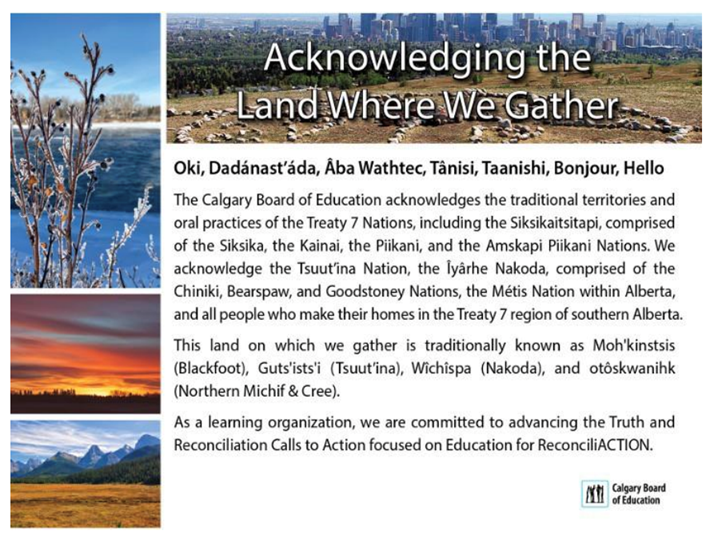
Oki, Tansi, Danit'ada, Umba-watich, Tawnshi, Bonjour, Hello.
As a learning community, Discovering Choices is committed to furthering our commitment to truth and reconciliACTION. The Calgary Board of Education’s Holistic Life-Long Learning Framework states “Indigenous ways of being, belonging, doing, and knowing enhance learning for all students and staff. As we engage in developing our “knowledge and understanding of, and respect for, the histories, cultures, languages, contributions, perspectives, experiences and contemporary contexts of First Nations, Métis and Inuit” (Alberta Teaching Quality Standard, 2020, p. 5) educators are required to weave in Indigenous knowledge for the benefit of all students” (p. 4). As a school, we actively seek out and engage with community members, Elders and Knowledge Keepers to provide opportunities for students to learn from the land and authentic voices and support families. At Discovering Choices, we currently work with The Aboriginal Friendship Centre of Calgary, Miskanawah Community Services, The CPS Indigenous Relations Team, Tsuut’ina Education and the Calgary Board of Education’s Indigenous Education Team. We strive to ensure that all parties have equal voice in the education of youth as we continue to move forward in achieving the Truth and Reconciliation Commission’s calls to action 62-64.
Our Indigenous Studies 10/20/30 programs are designed to provide students with authentic and experiential learning opportunities where reconciliACTION can take place. Numerous times throughout the year students are given the opportunity to foster a relationship with the land and work towards learning about Canada’s colonial past. Students may also earn Indigenous Studies credits alongside Social Studies 10 and 20 requirements as our commitment to decolonize education. For more information, please do not hesitate to reach out to the school directly.
Acknowledgement of the Land
Acknowledging the land where we gather demonstrates our ongoing commitment to the original spirit and intent of Treaty 7, also known as the Blackfoot Treaty. This agreement is to share the land and live well together, in peace for ‘as long as the sun shines, the grass grows, and the river flows.’ This acknowledgement is an act of Truth and Reconciliation to honour the Indigenous peoples who have cared for their traditional territories since time immemorial and leads us to consider our individual and collective roles and responsibilities to the treaty relationship.
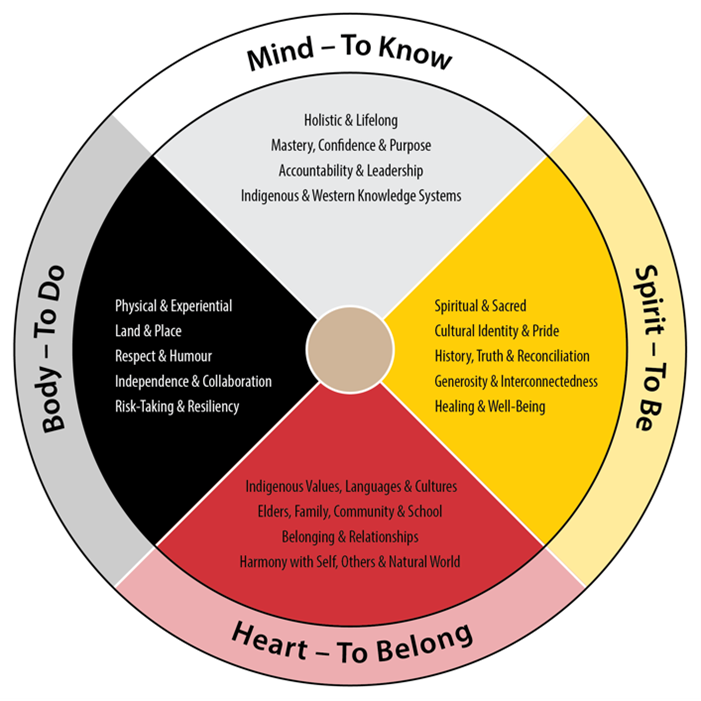
The Indigenous Education Holistic Lifelong Learning Framework
The Indigenous Education Holistic Lifelong Learning Frameworksets out the structure of foundational knowledge (four domains) and the underlying attributes essential to ensuring our success as an organization in achieving these key actions over three years and beyond. The framework is not a “how-to” guide for Indigenous Education or a recipe for closing gaps. Rather, it provides a foundation upon which individual staff members, teams, schools (including students and community), service units, and our district can meaningfully position and deepen our individual and collective knowledge, decisions, and actions to meet the holistic needs of all students.
The Indigenous Education Holistic Lifelong Learning Framework expands on the Indigenous Education Holistic Lifelong Learning Visual (shown below) that was inspired by the UNESCO Four Pillars of Education(1996), the work of the Canadian Council on Learning (CCL)(2007), and knowledge shared by Indigenous Elders and Knowledge Keepers. Passed on through stories, Elders and Knowledge Keepers have offered significant wisdom and guidance to design a framework representative of traditional and contemporary Indigenous ways of being, belonging, doing, and knowing.